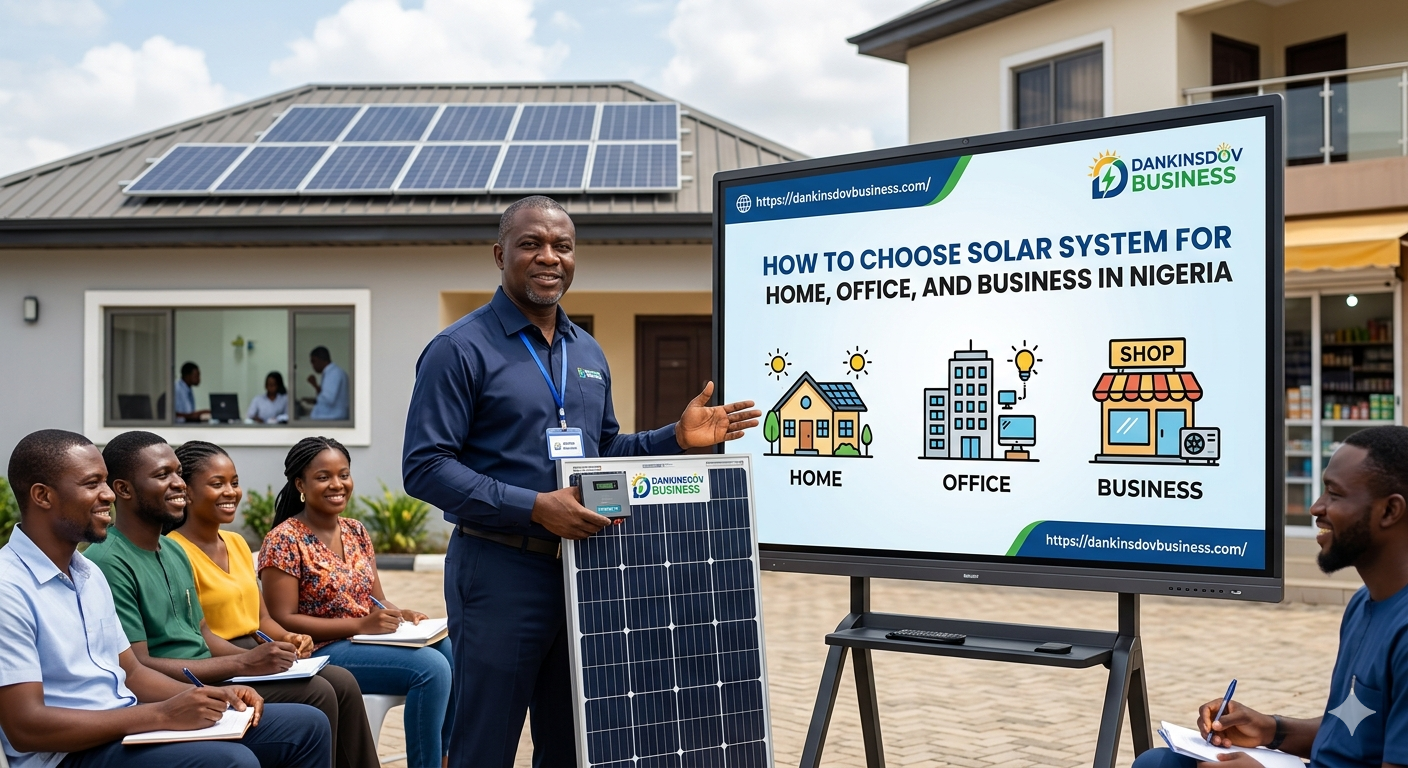
How to Choose Solar System for Home, Office, and Business in Nigeria
As electricity problems continue to affect many parts of Nigeria, both homes and businesses are feeling the impact every day. Many business owners are losing goods and income due to constant power outages, while households are also struggling with food spoilage because there is no reliable way to preserve items without electricity.
On top of that, many people find it difficult to charge and power their essential appliances, making daily life and business operations even more stressful. Because of these challenges, more Nigerians are now looking for reliable alternatives like solar power to stay powered and productive.
Why Solar Is Becoming the Solution in Nigeria
Solar energy has shifted from being a luxury for the wealthy to a practical necessity for the average Nigerian home and business due to several key reasons:
1. Unstable National Grid
Nigeria’s national grid has become one of the major reasons Nigerians have not experienced stable electricity over the past few years. The system has suffered repeated collapses, reportedly over a dozen times in 2024 alone. From mid-2025 into early 2026, the situation has continued to worsen rather than improve.
As a result, many households and businesses now depend heavily on alternative power sources. Interestingly, even the Federal Government has increasingly turned to solar energy in some facilities, including parts of Aso Rock, to ensure more stable electricity supply.
2. High Cost of Fuel
The removal of fuel subsidies and the floating of the Naira have caused petrol and diesel prices to rise sharply. As a result, running generators—popularly known as “I better pass my neighbour”—has become increasingly expensive for the average Nigerian.
Fuel now sells in the range of ₦1,000 to ₦1,500 per litre in many areas. For most households and small businesses, sustaining generator use is no longer realistic. Monthly fuel consumption of about 5 to 10 litres daily can amount to roughly ₦200,000 to ₦500,000, which in many cases is more expensive than installing a solar system.
3. Advancement in Technology
In the past, solar energy was considered expensive and unreliable due to low battery lifespan and high installation costs. However, this has changed significantly.
A major improvement is the shift from traditional lead-acid batteries to lithium-ion (LiFePO₄) technology. These batteries last longer, charge faster, and require less maintenance.
In addition, companies like Sun King and others are now producing more affordable solar solutions for households, including solar lights, solar refrigerators, and compact solar generators, making solar energy more accessible than ever.
4. Government and Policy Shifts
There is also growing support for renewable energy at different levels of government and private institutions. As grid electricity continues to struggle, solar energy is increasingly being adopted as a backup and, in some cases, a primary power source for public and private facilities.
5. Quality of Life and Health
Beyond cost and reliability, solar energy improves quality of life. It reduces dependence on noisy and polluting generators, lowers exposure to fumes, and provides a cleaner and safer environment for homes and businesses. This makes it not just an economic choice, but also a health and environmental one.
For assistance, get in touch for a free consultation and quote
Solar vs. Generator Cost Comparison (at ₦1,500/Litre)
| Cost Category | Generator (Petrol) | Solar Power System |
| Initial Setup Cost | ₦300,000 - ₦700,000 | ₦2,500,000 - ₦3,500,000 |
| Daily Fuel (7.5L avg) | ₦11,250 | ₦0 |
| Monthly Fuel (30 days) | ₦337,500 | ₦0 |
| Annual Fuel Cost | ₦4,106,250 | ₦0 |
| Maintenance | ₦180,000 / year | ₦5,000 / year |
| 3-Year Total Expense | ₦13,358,750 | ₦3,015,000 |
| Noise & Fumes | High / Constant | None (Silent) |
| Lifespan | 2 - 4 Years | 10 - 25 Years |
How to Choose Solar Energy for Your Needs
Solar systems are not random—they are designed and sized based on specific energy needs. The main factors include:
1. Load
This refers to everything you want to power in your home or business. Examples include lights, TV, air conditioner, fans, refrigerator, WiFi router, and other appliances. The higher your load, the bigger the solar system you will need.
2. Inverter Size (kVA)
Inverters are grouped based on their capacity, and this determines how much load they can handle. They typically range from 1kVA to 30kVA or more depending on usage.
Common sizes include:
- 1kVA – Small homes (basic lighting and phone charging)
- 3kVA – Medium homes (more appliances, fans, TV, small fridge)
- 5kVA – Large homes / small offices
- 10kVA+ – Offices and business setups
3. Battery Storage
Batteries store the energy your solar system generates. They are mainly of two types:
- Lead-acid batteries: Cheaper but have a shorter lifespan and require more maintenance
- Lithium (LiFePO₄) batteries: More expensive but last much longer, charge faster, and are more efficient
Your choice of battery greatly affects both performance and long-term cost.
For assistance, get in touch for a free consultation and quote
Solar System Sizes Based on Usage
1. Small House System
A small house refers to an average Nigerian home with basic electricity usage.
It can comfortably power:
- 4–6 LED lights
- 2–3 fans
- TV
- Phone charging
- WiFi router
If your household uses more than this, you may need to consider a medium system.
Cost of Solar for a Small House
A working solar system for a small home in Nigeria costs approximately ₦1,200,000 – ₦1,800,000, depending on the number of panels and battery type.
Recommended system setup:
- 1kVA – 2kVA inverter
- 2–4 solar panels (450W each)
- 1–2 batteries
Estimated cost breakdown:
- Lead-acid system: ₦500,000 – ₦1,200,000
- Lithium system: ₦900,000 – ₦1,800,000
2. Medium House System
A medium system is designed for homes with higher electricity usage and more appliances. It can support most household needs comfortably, but may not handle all heavy appliances at once.
It can power:
- Lights in multiple rooms
- Fans in all rooms
- Fridge/freezer
- TV + decoder
- Charging devices
Cost of Medium House System
A medium solar system typically costs between ₦1,500,000 – ₦5,000,000, depending on components and battery type.
Recommended system setup:
- 3kVA – 5kVA inverter
- 4–8 solar panels (450W–550W)
- 2–4 batteries
Estimated cost breakdown:
- Lead-acid: ₦1.5M – ₦3.5M
- Lithium: ₦2.5M – ₦5M
3. Office Solar System
Office systems are designed for more consistent and heavier energy usage compared to homes. They help reduce downtime and ensure smooth business operations.
It can power:
- Computers
- Printers
- WiFi systems
- Lighting
- Small air conditioners (depending on size)
If these are your main office needs, this setup is highly recommended to avoid power disruption.
Cost of Office Solar System
A standard office solar setup in Nigeria costs approximately ₦4,000,000 – ₦12,000,000, depending on capacity and battery type.
Recommended system setup:
- 5kVA – 10kVA inverter
- 8–16 solar panels
- Lithium batteries preferred
Estimated cost breakdown:
- Lead-acid: ₦3M – ₦6M
- Lithium: ₦5M – ₦12M
4. Large Business / Industrial System
This system is designed for heavy-duty energy needs such as factories, large offices, and industrial setups.
It can power:
- Multiple air conditioners
- Heavy machines (depending on system design)
- Entire office blocks or facilities
Recommended system setup:
- 10kVA – 30kVA+ inverter
- 20–60 solar panels
- Large lithium battery bank
Estimated cost:
- ₦10M – ₦50M+ depending on scale and energy demand
For assistance, get in touch for a free consultation and quote
Solar Installation Costs in Nigeria
The total cost of solar installation in Nigeria depends on your energy needs, equipment quality, and system size. While the initial investment may seem high, solar often pays for itself over time due to reduced fuel and electricity costs.
| System Size | Capacity (Typical Appliances) | Estimated Total Cost (₦) | |
| 1.5kVA | Basic: Lights, Fans, TV, Laptops | ₦750,000 – ₦1,200,000 | |
| 3.5kVA | Mid-range: Fridge, TV, Fans, Pumps | ₦1,800,000 – ₦3,500,000 | |
| 5kVA |
|
₦3,500,000 – ₦5,800,000 | |
| 10kVA | Premium: Multiple ACs, Large Building | ₦7,500,000 – ₦12,000,000+ |
|
|
Choosing the right solar system is not about guessing—it is about understanding your energy needs, your budget, and the type of appliances you want to power. As electricity challenges continue in Nigeria, solar energy is no longer just an alternative but a long-term solution for homes, offices, and businesses.
Whether you are starting small or planning a large installation, the key is to properly size your system so you avoid underperformance or unnecessary costs.
Action Plan for You
If you are considering switching to solar, here’s what you should do next:
- Calculate your load – List all the appliances you want to power.
- Choose your system size – Small, medium, office, or industrial based on your needs.
- Decide your battery type – Lithium for long-term value or lead-acid for lower upfront cost.
- Plan your budget – Compare system cost with your current fuel and electricity spending.
- Get professional guidance – Do not guess; proper installation determines system performance and lifespan.
Next, I will explain how many solar panels you actually need for different setups, so make sure you check back on this site.
We provide reliable and affordable solar energy solutions for homes, offices, and businesses across Nigeria. Whether you need a small home setup or a large industrial system, we are ready to design, supply, and install a system that fits your exact energy needs.
We don’t just sell solar systems—we provide complete solutions, including consultation, installation, and support.
👉 Visit our solar service page here: DankinsDov Business Solar Systems & Installation